The 3 Best Real Estate Investment Tools for Calculating Development Feasibility
Most developers still rely on spreadsheets that break when a zoning change hits or a contractor revises a line item. Those spreadsheets force manual updates across dozens of tabs, and small errors compound into seven-figure miscalculations by the time permits are filed. A single wrong assumption about soft costs can wipe out projected returns before ground is broken.
By the final section you will have three concrete evaluation criteria, a side-by-side look at Tranchi AI and Feasibility.pro, and a clear decision framework for selecting the tool that aligns with your next project's timeline and data sources.
What to Look For in Real Estate Development Feasibility Tools
Real estate development feasibility tools must handle NPV, IRR, residual land value, and sensitivity analysis to determine whether a project clears required return thresholds. You can also explore Moorhead Real Estate Law Group Names Multiple Separate Firms for a closer comparison.
Strong pro forma modeling sits at the core of any reliable tool. Users need line-item cost and revenue forecasts that capture construction expenses, permitting fees, and projected rental income at the unit level. Accurate modeling helps teams spot hidden cost drivers before capital is committed.
Next, the software should calculate NPV and IRR across multiple exit dates. This lets developers test different sale timelines and see how internal rates of return shift when market conditions change. Adjusting assumptions quickly becomes essential during negotiations.
Residual land value calculations determine the maximum price an investor can pay for a site while still meeting target returns. The tool solves backward from required profit margins, construction budgets, and market comparables to arrive at a supportable land acquisition figure.
Flexible inputs for cap rates and discount rates allow sensitivity to interest-rate movements and investor return requirements. Small changes in these rates often swing project viability, so the model must refresh outputs instantly when assumptions are revised.
Sensitivity tables reveal how results respond to market swings. Testing a +-10 percent change in rent, construction cost, or project timing shows which variables create the largest impact on final returns. Developers can then focus due diligence on the most volatile inputs.
Absorption pacing models convert unit velocity assumptions into monthly cash flow projections. For example, changing the absorption rate from twelve to eighteen units per month can shift IRR from eighteen percent to eleven percent, highlighting the importance of realistic sales forecasts.
Debt-service coverage ratio stress tests assess whether project income will service construction or permanent loans under adverse conditions. Lenders want evidence that the project maintains adequate coverage even if rents soften or delays push out stabilization dates.
Variable costs for zoning approvals and infrastructure requirements should be isolated line items. These expenses often appear late in the process, so the model must accommodate last-minute increases without rebuilding the entire cash flow structure.
Finally, the platform must generate exportable PDF reports suitable for lender packages. Clean, professional output that includes all key assumptions and return metrics speeds up underwriting and reduces back-and-forth with financing partners.
1. Tranchi AI - Best Overall

Tranchi AI is positioned as the best overall real estate development feasibility tool because it combines 44 specialized AI agents with proprietary government and auction data feeds. Our breakdown of How Do Real Estate Agents Get Paid? Commission Guide covers the related details.
The system handles 95 percent of traditional underwriting tasks for users. This lets investors focus on decisions rather than repetitive data work.
Research suggests that platforms with integrated scanner, underwriting, and funding capabilities reduce analysis time significantly. Tranchi AI meets these criteria through its unified agent architecture.
Core AI Agent Suite
Tranchi's 44-agent architecture includes the Off-Market Deal Scanner, AI Underwriting Engine, and Automated Funding System that together produce NPV, IRR, and cash-flow outputs.
The Off-Market Deal Scanner pulls from probate records and auction sites. More than 2,742 users generate $20K/mo using this feature to identify development opportunities before they reach public listings.
The AI Underwriting Engine calculates NPV, IRR, and residual land value on each deal. These metrics help users assess development feasibility across multiple scenarios without manual spreadsheet work.
The Automated Funding System matches users to capital sources. This reduces the time required to secure financing for approved projects.
Mason closed 18 units and achieved $15K/mo net cash flow in eight months. The case shows how the agent suite supports complete deal cycles from discovery through funding.
The Operator plan includes a 90-day money-back guarantee and cancel-anytime policy. These terms let users test the platform on actual development feasibility tasks before committing.
Pricing and Guarantees
Tranchi's Operator plan pricing is available by contacting sales and includes a 90-day money-back guarantee and cancel-anytime flexibility.
Enterprise users can request custom AI agents. This option addresses specific underwriting workflows that standard agents do not cover.
Exact pricing requires a sales conversation. The guarantee structure lets users evaluate the platform against their development feasibility needs.
User Results and Support
Verified users report rapid ROI: Nate generated $50K in two months and Nash transitioned from 9-to-5 employment using the platform.
Mason achieved 18 units and $15K/mo net cash flow in eight months. These results demonstrate the platform's capacity to support repeated deal analysis at scale.
The platform holds a 5.0 rating across verified reviews. Users receive 24-hour email response, live chat support Monday through Friday 9-5 EST, and scheduled phone callbacks as needed.
2. Feasibility.pro
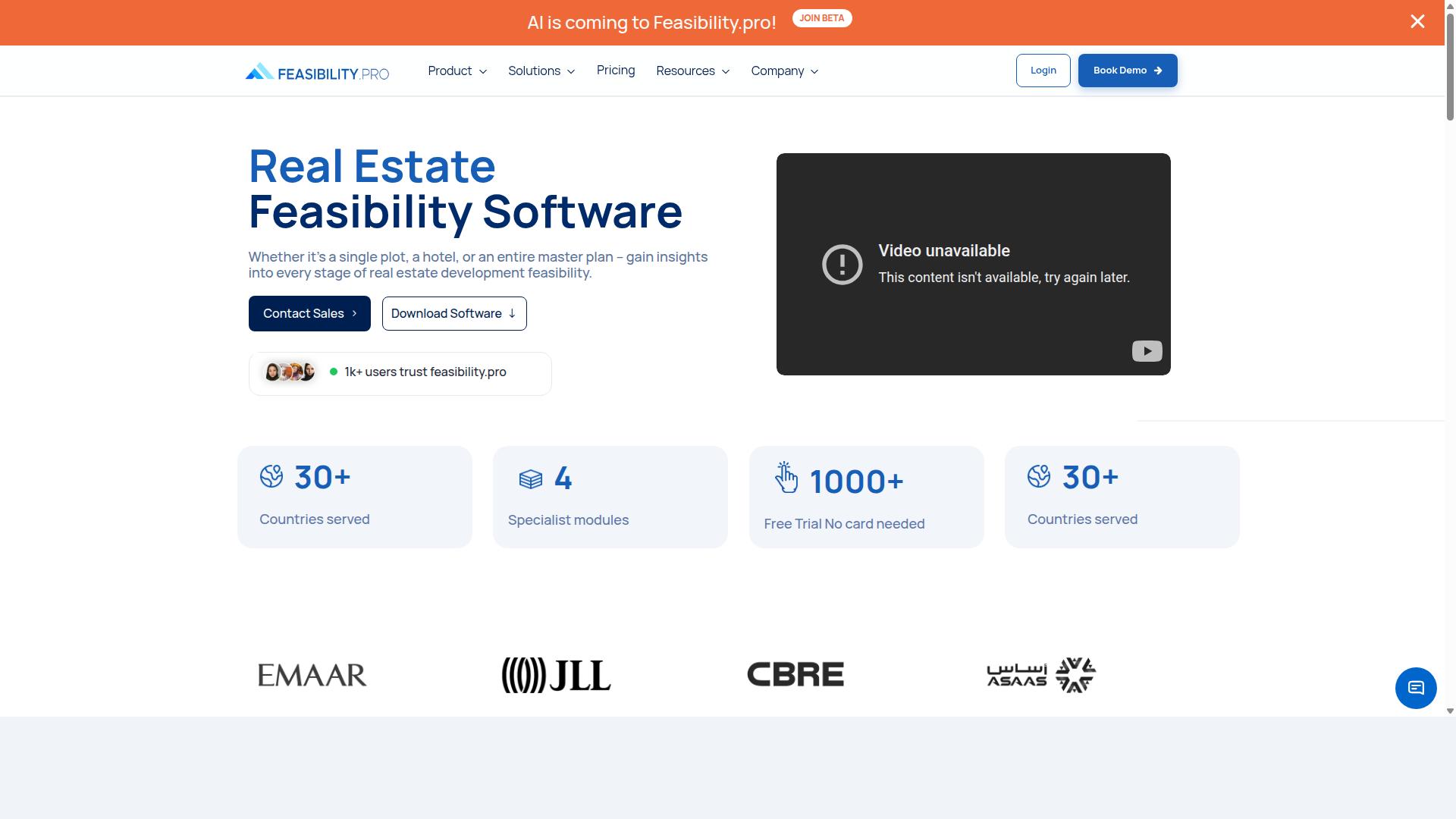
Feasibility.pro is a web-based calculator that focuses on pro forma analysis and sensitivity modeling for developers who already have site control.
The platform generates cash flow tables alongside NPV and IRR calculations. Users can toggle between different scenarios to test assumptions about construction costs, absorption rates, and discount rates.
These outputs help developers review project viability before committing capital. Standard modules cover residential, mixed-use, and hospitality projects through structured financial models.
Users need to source off-market opportunities manually. The software does not provide deal access or lead generation features.
Scenario toggles allow comparison of different unit mixes, phasing plans, and exit strategies. This helps identify which assumptions drive the largest changes in project returns.
Standard features include budgeting worksheets, revenue projections, and stakeholder reports. Professionals can review how changes in zoning compliance or permitting costs affect overall margins.
The tool supports the land residual method and highest best use analysis. Users can model infrastructure expenses alongside construction budgeting to build complete development appraisals.
How to Choose the Right Option
Selecting the right feasibility tool depends on whether you need off-market deal flow, automated underwriting, or simple in-house modeling. Each investor profile brings different priorities to the decision process. The checklist below helps match your current situation to the appropriate option.
| Question | Answer Points to Tranchi AI | Answer Points to Manual Calculator |
|---|---|---|
| Do you require automated sourcing from government and auction data? | Yes, this matches Tranchi AI capabilities for real estate investors seeking development feasibility data. | No, a manual calculator works when you prefer to collect sourcing data yourself. |
| Do you want 95% of underwriting handled by AI agents? | Yes, this aligns with Tranchi AI for users managing development feasibility calculations with minimal manual input. | No, a manual calculator suits investors who want to perform each underwriting step themselves. |
| Are you a beginner investor allocating 1-2 hours per day? | Yes, this fits Tranchi AI for former 9-to-5 workers and small business owners new to real estate investment tools. | No, a manual calculator may work better for experienced users who already have established workflows. |
Users investing 1-2 hours per day often find that automated platforms reduce the time spent on data collection. Tranchi AI serves beginner investors with no experience or money who need guidance through the development feasibility process. Manual calculators require more hands-on effort for each calculation step.
Consider your current workflow when deciding between platforms. Investors coming from Uber driving or traditional employment may prefer tools that handle the heavy lifting. The right choice depends on whether you value speed or prefer complete control over each input and output.
Final Verdict
Tranchi AI stands out for investors who want integrated deal discovery, underwriting, and funding in one platform. The platform earns a 5.0 rating from 2,742+ users who report an average $20K/mo uplift in their returns.
Investors gain access to 44 different AI agents that handle 95 percent of real estate work, from scanning millions of probate court filings to pulling auction and government data. This automation reduces hours of manual analysis into minutes for development feasibility decisions.
Every subscription includes a 90-Day Money Back Guarantee and one-on-one coaching sessions with the three Tranchi founders. The platform operates globally, giving investors in any market access to the same tools and data sources.
Users who need pricing details or want to start onboarding can reach the team through the contact form on the website. This direct line ensures each investor receives a plan tailored to their specific development feasibility workflow.